




Pico Laser
At Reborn Avenue, you are the center of attention – we help you highlight your natural beauty with precision and care.
Picolaser & Fractional Picolaser
For a clearer and smoother skin
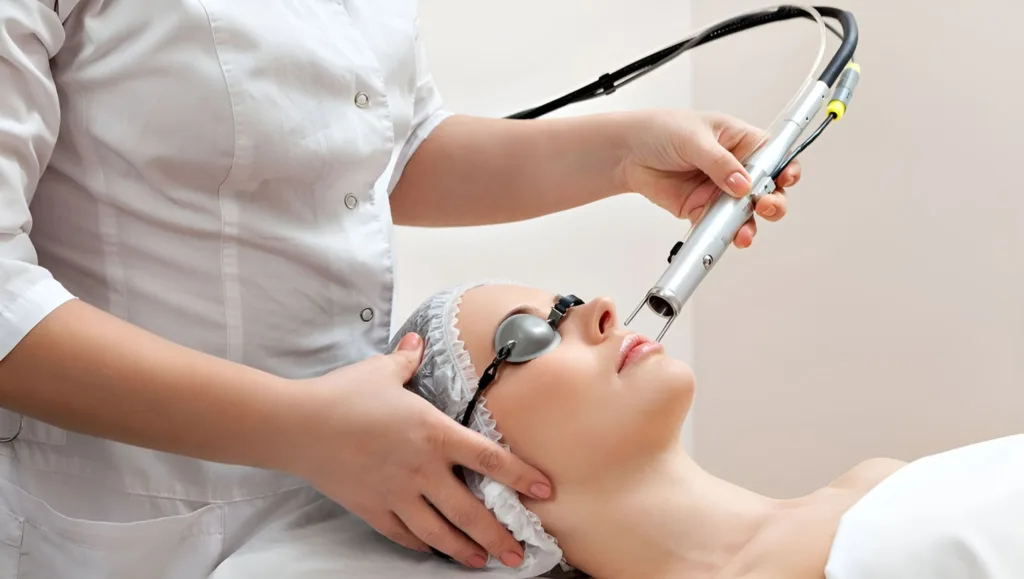
Picolaser is an advanced laser technology used to treat pigment spots, sun damage, birthmarks and to stimulate skin rejuvenation. At Reborn Avenue in Helsingborg, we work with two wavelengths – 532 nm and 1064 nm – which makes it possible to treat different types of pigments and skin conditions in a safe and effective way.
Unlike traditional lasers, Picolaser uses ultra-short pulses in picoseconds, meaning that the energy is delivered in extremely fast bursts. The technology creates pressure waves that break pigment particles into microscopic fragments, making it easier for the body to transport them away naturally – without damaging surrounding tissue. This makes the treatment both gentle and effective, even for sensitive skin.
We also offer fractional treatment with Picolaser, where the energy is distributed in small, closely spaced points. This stimulates the skin's natural healing processes and collagen production without affecting the entire skin surface. The result is a smoother skin texture, reduced pores and increased radiance - perfect for those who want skin rejuvenation with minimal recovery.
The treatment is individually adapted based on skin type, needs and which area is treated. Whether you want to reduce sun damage, remove pigment changes or refresh the skin's structure, Picolaser is a modern and gentle alternative. At Reborn Avenue in central Helsingborg you get a safe, result-oriented treatment in a professional environment.
Consultation
Booked Online
Processing time
20 - 30 minutes

Time to wake up your skin life?
Evener tone, healthier skin
Picolaser and fractional Picolaser are powerful yet gentle treatments for those who want to improve skin tone, texture and radiance – with visible results. Here are some signs that your skin may benefit from the treatment:
- Uneven skin tone or sun spots
- Dull and tired skin
- Enlarged pores
- Rough or aged skin texture
- Pigment marks after pimples or sun exposure
- Skin feels dull despite skincare routine
- Want results with short recovery time
- Want something deeper than a classic facial?
Your guide to safe & effective treatment with Picolaser
Picolaser - Questions & Answers
What can I treat with Picolaser?
Picolaser is excellent for treating sun damage, age spots, melasma and certain types of benign moles. The fractional version is also used for skin rejuvenation and improving skin texture.
What is the difference between Picolaser and fractional Picolaser?
Picolaser uses ultra-short laser pulses to break down unwanted pigment in the skin, such as sunspots, melasma or birthmarks. The concentrated beam treats specific areas with high precision, meaning that many people see clear improvement after just one treatment.
Fractional Picolaser instead works with a special handpiece that distributes laser light in a fine dot pattern across the skin. This creates small microscopic treatment zones that stimulate collagen and improve skin texture, firmness and radiance.
At Reborn Avenue we use both 1064 nm and 532 nm in our fractionated treatment:
• 1064 nm reaches deeper into the skin and works on skin structure and firmness
• 532 nm works more superficially and is effective against pigment and uneven skin tone
Together, they make it possible to treat both superficial and deeper skin problems in the same session – with minimal recovery time.
How does the treatment feel?
Most people describe the treatment as slightly stinging or warm, but not painful. A fractional treatment can feel slightly more intense, but is overall very gentle thanks to the short pulses and precise technique.
Is there any recovery time?
When treating pigment with Picolaser, there is often a slight redness immediately afterwards, and the pigmented area may darken slightly. Within a few days, a thin crust forms, which then falls off on its own after about 7–10 days. During this time, you should avoid picking or exfoliating the skin so as not to disrupt the healing process.
With fractional Picolaser, the skin may become red, warm and slightly swollen for up to a few days. Since the treatment stimulates the deeper layers of the skin, recovery takes a little longer, but you can usually return to everyday activities immediately afterwards.
How many treatments are needed to see results?
The number of treatments depends on the skin's initial condition, the type of problem being treated, and the result you want to achieve.
At pigment treatment with Picolaser, where we work with a concentrated and targeted laser beam to break down the pigment, sometimes a single treatment may be enough – especially for superficial sun spots or minor pigment changes. In other cases, additional treatments may be needed, usually 4–6 weeks apart, to achieve an even and lasting result.
At fractional Picolaser, where the laser works more comprehensively and pointwise to stimulate collagen and improve skin structure, usually requires 3–6 treatments depending on the condition of the skin. Since we work with the skin's own healing process, the improvement occurs gradually over time.
Should I avoid the sun afterwards?
Yes, it is very important to avoid direct sun exposure for at least 4 weeks after treatment. Always use sunscreen with at least SPF 30 to protect your skin and maintain the results.
Can I have Picolaser if I have dark skin?
The treatment can be adapted to different skin tones, but some pigment types require caution. Therefore, we always make a careful assessment during the consultation to ensure that the treatment is safe and effective for your skin.
Are there any contraindications for Picolaser?
Yes, there are some times when we do not recommend Picolaser treatment. You should avoid the treatment if you are pregnant or breastfeeding, have an active skin infection, ongoing acne breakouts in the treatment area, open wounds or have recently been exposed to the sun. We also do not treat if you have taken isotretinoin (Roaccutane) in the last 6-12 months, or if you are using strong retinoids that make the skin sensitive.
People with very dark skin (Fitzpatrick V–VI) should also undergo a careful consultation before treatment, especially when using 532 nm, as the risk of pigment changes is higher.
An individual assessment is always made before your first treatment to ensure that Picolaser is safe and effective for you.